AUD
Auditing and Attestation — the fourth of the four sections I sat for.
September 16, 2019
Started Audit
Studying alongside a full course load, RA duties, and campus organizations.
Weeks 1–4
First pass
Worked through the Becker lectures and content, 2–3 modules a day.
October–November
Review, with shortcuts
MCQs, simulations, flashcards, and mock exams — but in hindsight, sometimes treating strong MCQ scores as proof I understood a topic.
November 11, 2019
First attempt
Walked out feeling like it had gone extremely well.
November 22, 2019
Didn't pass
Found out I'd failed, and rescheduled the very next morning.
Late Nov–Dec
Diagnosing the gaps
Built a list of what I didn't actually understand, instead of just studying more.
January 2, 2020
Retake
Second attempt, 8:00 AM, during winter break.
February 3, 2020
Passed Audit
Fourth and final section — the CPA exams were done.
I took AUD in 2019 and 2020. The CPA exam itself and Becker's software have both changed since then — but the study techniques below still hold up.
How I Passed Audit — On the Second Try
Audit was my fourth and final section, and the only one I didn't pass on the first try. I'd gotten through REG, FAR, and BEC in one summer, each on the first attempt — by Audit, I had a study system that worked. That's part of what made Audit interesting: the system had worked three times, and that success made me confident enough to take shortcuts I didn't fully notice I was taking.
Studying During My Final Year of College
I started studying for Audit on September 16, 2019 — a few weeks into the first semester of my fifth year. Unlike REG, FAR, and BEC, which I studied for mostly over the summer with few other obligations, Audit meant studying around a full course load, my RA position, and a couple of campus organizations.
Studying for the First Attempt
I got through the Becker lectures and content in about four weeks — 2 to 3 modules a day: lectures, notes in the book, MCQs, and simulations. When something felt unclear, I'd rewatch a lecture, reread the book, or just do more MCQs.
After that, most of my remaining time before the exam was review: Becker mock exams, a lot of MCQs, simulations, digital flashcards, and the same retrospective revision timetable I'd used since REG. I also kept working cumulative MCQs from earlier chapters so nothing got stale.
Why I Thought I Was Ready
In hindsight, I took some shortcuts. The biggest one: if I was scoring well on the MCQs for a section, I assumed I understood the material well enough. That approach had worked for REG, FAR, and BEC, so by Audit I trusted it without questioning it much.
I also skipped Becker's Final Review this time, something I'd done for every other section. I can't say either of those things on its own explains what happened next — but they were both true of how I studied for the first attempt, and both were things I changed for the retake.
November 11: First Attempt
I took the exam on November 11, 2019. I walked out feeling like it had gone extremely well — genuinely one of the more confident exits I'd had across all four sections.
Finding Out I Didn't Pass
I found out on November 22, 2019, that I hadn't passed. The night was not fun. I rescheduled the retake the next morning, for January 2, 2020, at 8:00 AM — the first available slot in the new year.
What I Changed for the Retake
Failing meant I had about five weeks before the retake, and this time I spent them differently. Instead of assuming a good MCQ score meant I understood a topic, I tried to find the specific things I couldn't actually explain.
I made a Google Doc and started listing out topics and terms I couldn't confidently explain — some of them things I'd been answering correctly on MCQs — and worked through them one at a time.
I also borrowed physical Becker flashcards from a friend who worked at a Big Four firm. At the time, they were more detailed than the digital flashcards I'd been using, and going through them made it clear that some of what I thought I knew was closer to recognizing the right answer than actually understanding it.
I used Becker's personalized review sessions more deliberately this time, since they pushed more practice toward whatever I was weaker on rather than spreading it evenly across everything. And I completed Final Review, which I'd skipped the first time around.
I can't say any one of these — the Google Doc, the flashcards, personalized review, Final Review, or the extra uninterrupted time over Christmas break — was the reason the second attempt worked. They were the differences between the two attempts, and together they changed what I was actually doing with my study time: less accumulating MCQs, more figuring out what I didn't understand.
Using Active Recall in My Spreadsheet
One thing I built into the Audit spreadsheet was a simple active-recall system: I'd write a question in one cell, then type the answer into another cell and set its font to white, so it disappeared against the white background. I'd look at the question, try to answer it from memory, and only then check whether I was right.
I got the idea from an Ali Abdaal video on active recall: hide the answer, force yourself to retrieve it, then check whether you were right. It's a simple system, but it forces retrieval instead of recognition — which was exactly the gap the first attempt had exposed.
The Retake and Finding Out I Passed
I sat for the retake on January 2, 2020, at 8:00 AM. On February 3, 2020, I found out I'd passed — the fourth and final section, and probably the happiest I've ever been about a login screen. That closed out a CPA exam journey that had started on May 1, 2019.
My Audit Retrospective Revision Timetable
REG and FAR already cover how the retrospective revision timetable works, so I won't re-explain the color system here. Audit is a good example of just how long that process became. One topic, Professional Standards, has nine separate review dates recorded between September 11 and October 16.
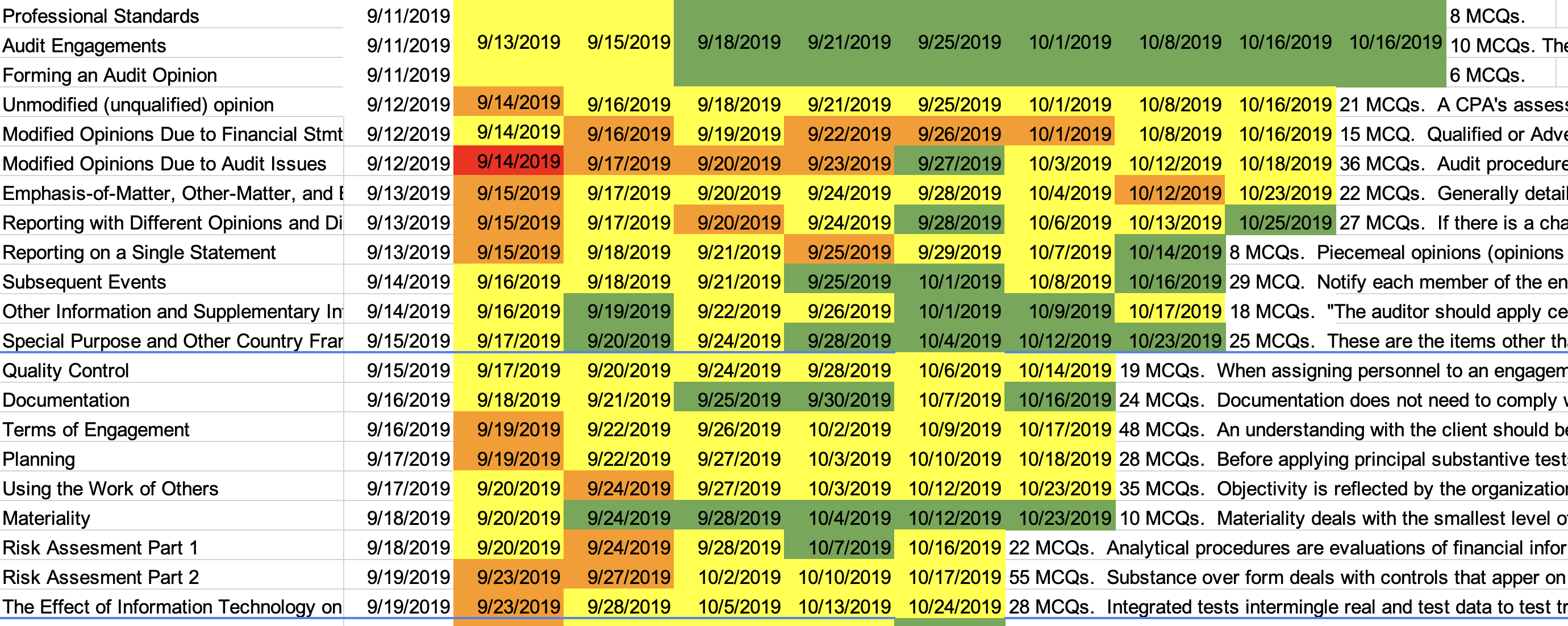
The workbook also had a tab of harder topics with mnemonics I made up to keep things straight — PRIME, for the subsequent-events procedures (post-balance-sheet transactions, rep letter, inquiry, minutes, examine interim financials), is one that's stuck with me since.
Here's the full Google Sheet if you want to see the rest.
After the Exams
One reason I pushed to finish before my last semester was that I wanted to enjoy it without the CPA exam hanging over me. I got about a month of that before COVID shut down campus and sent everyone home. Instead of a normal graduation, about 15 of us — close friends from the accounting program — had a backyard graduation of our own.