BEC
Business Environment and Concepts — the third of the four sections I sat for.
July 27, 2019
Started BEC
Same day I sat for FAR — the smaller book and familiar material made the first few modules feel manageable.
Weeks 1–3
First pass
Lectures, MCQs, and simulations, while keeping older material fresh with cumulative MCQs and flashcards.
Weeks 4–5
RA training
Full-time RA training took over weekdays — the goal shifted from learning new material to retaining what I already knew.
Weeks 4–6
Three-pile flashcards
A daily / every-other-day / every-three-days rotation kept review efficient through the rest of the study period.
Final week
Cumulative review
RA training over — back up to 200+ MCQs a day, the full flashcard stack, and mock exams.
September 9, 2019
Exam day
Sat for BEC after six weeks of studying, feeling more prepared than REG or FAR.
I took BEC in 2019. BEC is no longer one of the current CPA Exam sections, and the exam itself and Becker's software have both changed since then — but the study techniques below (scheduling backward from an exam date, cumulative review, MCQs, flashcards, active recall) still hold up.
I had an unusual amount of time to study for these exams. I was still in college, studied for most of them over the summer, and didn't have a full-time job or family responsibilities. Six weeks worked for me — that doesn't mean six weeks is the right timeline for you.
How I Passed BEC in 6 Weeks
BEC was my third exam, right after passing REG and FAR back to back. By this point I had a study system that actually worked — the harder part this time wasn't figuring out how to study. It was fitting that system around a schedule that changed dramatically halfway through, when two weeks of full-time RA training took over my days.
Starting BEC the Same Day I Took FAR
I started studying for BEC on July 27, 2019 — the same day I sat for the FAR exam. I probably should have taken a day to decompress after FAR, which is generally considered the hardest of the four sections. But I had time to kill before an event that evening, so I went to a coffee shop, grabbed a snack, and got started. Because what's better than studying? (A lot of things, actually.)
By this point I'd been studying continuously since May 1 — REG in June, FAR earlier that same day. BEC's book was about half the size of FAR's, and the first few modules covered ground that felt familiar from FAR, which made for an easy start.
The next day, I got my calendar out and worked backward from my exam date — September 9, 2019, about six weeks away — to figure out what I needed to cover each day.
Weeks 1–3: Learning the Material
For each module — Becker has somewhere between five and ten per chapter — I'd go through the lectures, the skills practice, and the multiple-choice questions. Once I finished a chapter, I'd do the simulations, mostly to get comfortable with the format of the short-response questions. I didn't lean on these heavily, but they're worth doing at least once so you know what to expect. Every day I'd also work in MCQs or flashcards on whatever I'd already covered, so it didn't slip.
I got through all of the new content in about three weeks, then moved into Becker's Final Review during week four. I had a good enough grasp on the material by that point that I honestly didn't take Final Review very seriously. It's a great recap, and I think it helps on every section — I later skipped Final Review on my first Audit attempt and failed. I can't say that was the reason, but after that experience I wouldn't recommend skipping it. If you have access to a Final Review book, use it.
Weeks 4–5: Studying Around RA Training
Weeks four and five overlapped with RA training at UW–Whitewater — two weeks of full-time training that ran from about 7:30 AM to 5:30 PM every weekday. This was my fourth time going through RA training, so I was hoping for some kind of pass on the schedule. I did not get one.
Here's roughly what a weekday looked like:
- 5:30–7:00 AM: half of my flashcard stack, plus 60 Becker MCQs (about ten per chapter)
- After training and dinner, around 5:30 PM: the other half of the flashcards, plus another 60 MCQs
- The rest of the evening: RA work, socializing, or more studying, until bed around 10 PM so I could do it again the next day
The important part isn't the schedule itself — it's what changed. I'd already learned the material during the first three weeks. These two weeks weren't about learning anything new; they were about retention. The goal shifted from covering material to not losing it.
How I Used the Weekends
On the weekends across weeks three, four, and five, I'd study around meals and workouts rather than on a fixed schedule. Saturdays meant a Becker mock exam, and I'd spend the rest of the weekend working through whatever the results showed I was weak on — more MCQs, more flashcards, targeted review. Same system as the weekdays, just with more room to breathe.
My Three-Pile Flashcard System
I'd been watching study-technique videos from creators like Thomas Frank, Ali Abdaal, StudyMD, and Anas Nuur Ali, and spaced repetition kept coming up in all of them — review something right before you'd otherwise forget it, then stretch the interval out each time you get it right. Thomas Frank's video, The Most Powerful Way to Remember What You Study, laid out a five-box system I ended up adapting: review box 1 every day, box 2 every other day, box 3 once a week, box 4 once every two weeks, and box 5 right before a test.
I adapted that into something simpler for the CPA timeline. I made my own flashcards for equations, concepts, and definitions I found difficult — usually after I already had a decent grasp on something, not while it was still brand new — and sorted them into three piles instead of five:
- Pile 1 — every day
- Pile 2 — every other day
- Pile 3 — every three days
If I got a card wrong, or it was still difficult, it stayed in (or moved back to) the more frequent pile. If I got it right, it graduated to a less-frequent one.
This was spaced repetition, deliberately — not something I stumbled into by accident. The point was simple: I didn't want to spend the same amount of time on a card I already knew as one I kept getting wrong. Sorting them into piles meant the difficult ones came around constantly and the easy ones mostly got out of the way — which mattered a lot once RA training cut my available study time in half.
Final Week: Cumulative Review
By the last week, RA training was over and classes had just started — mostly syllabus days, so I had the time back. Each day I'd go through at least 200 MCQs, my entire flashcard stack, and reread anything I still found difficult. When something was hard, I tried to write it out — the equation, the journal entry, whatever it was — and quiz myself on it instead of just rereading and assuming I understood it.
I also went through each of the three mock exams once that week, about an hour each by that point since I'd already taken them a couple of times. I used them mostly as extra MCQ practice and to catch anything the regular course material hadn't covered.
I didn't take a single day off that week, including the day before the exam. Some people rest their mind the day before a test; for me it felt more like information leaking out, so I kept going.
Exam Day
I sat for BEC at about 8:00 AM on Monday, September 9, 2019, feeling more prepared than I had for REG or FAR combined. To be clear, that's a reflection of how I'd prepared and how the material sat with me personally — not a claim that BEC is an easy section. I paced myself instead of rushing, finished in about three and a half hours, and walked out feeling good. That said, feeling good walking out doesn't always mean you passed.
Finding Out I Passed
(Scores are usually available the night before the official release date, though I didn't know that yet.) I woke up early on September 19, 2019, sat there for about thirty minutes not wanting to look, and finally logged into CPA Central.
83.
It didn't feel quite as satisfying as REG or FAR, since BEC hadn't been as hard for me — but three sections down meant only Audit left, and that was enough to be thrilled about. (For what it's worth: this is the actual 83 — unlike the one I wrote in my planner before FAR and didn't get.)
My BEC Retrospective Revision Timetable
I used the same retrospective revision system for BEC that I used for REG and FAR. Each row represented a topic, and every time I came back to it I'd add the date and update the color based on how comfortable I felt with it.
I also left myself notes about what actually needed work. Some were broad reminders to reread a chapter; others were specific equations, ratios, or concepts I wanted to turn into flashcards. That kept the spreadsheet from being just a record of what I'd studied — it told me what to do the next time I came back.
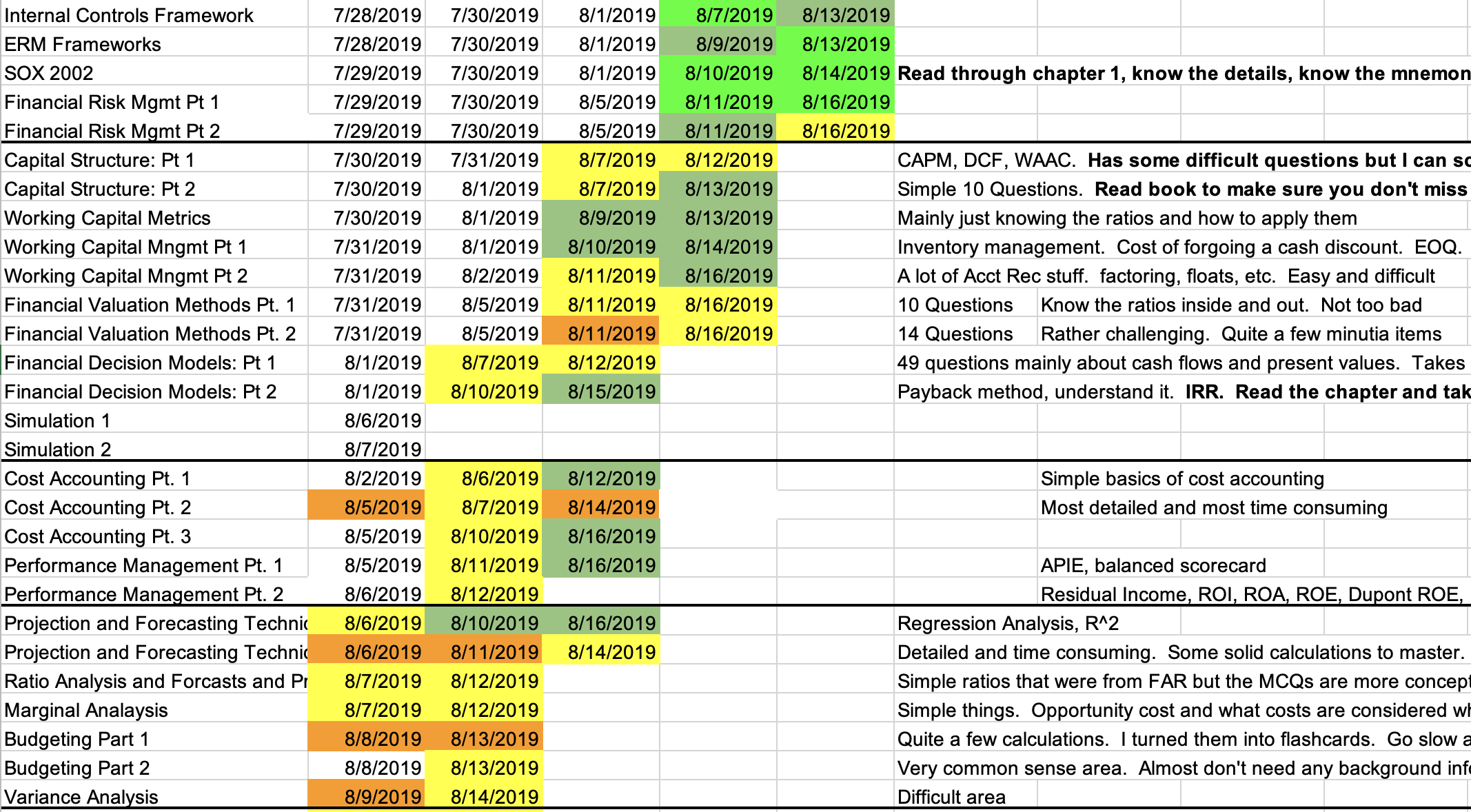
Here's the full Google Sheet if you want to see the rest.
Good luck!