REG
Regulation — the first of the four sections I sat for.
May 1, 2019
Start
Becker purchased — began the course.
Week 1
Building momentum
Daily module targets — learning how much work was realistic in a day.
Week 2
Adding review
New material continued while older chapters started coming back into rotation.
Week 3
First pass complete
All eight REG chapters covered — the question shifted from finishing to remembering.
Week 4
Cumulative MCQs
Large chapter-group MCQ sessions, then repeat passes on weak areas.
Week 5
Final Review + weak spots
Final Review, mocks, flashcards, simulations, and targeted repetition.
June 7, 2019
Exam day
Passed with a 78.
I took REG in 2019. The CPA exam itself and the Becker software have both changed since then, so some of the specifics below are dated — but the study strategies still hold up.
How I Passed REG in 6 Weeks
This was the scariest and most exciting of the four exams, since it was my first one. Once I got Becker purchased on May 1, 2019 and had my books, I was excited each day for the first couple of weeks to wake up and study as hard as I could, getting that much closer to becoming a CPA.
Weeks 1–3: Learning the Material
I was doing anywhere from two to four modules a day and got through all of the content in three weeks. Those three weeks went from exciting to overwhelming and stressful, since I was trying to keep up with all of the content in the previous chapters — REG has eight chapters. I realized it's natural to feel overwhelmed studying for these exams, since there's so much content to know.
My Retrospective Revision Timetable
The way I kept up on my knowledge was by using a retrospective revision timetable. Since it was basically impossible to brush up on all my old knowledge every single day, this Google Sheets technique helped me keep track of which modules I hadn't looked at in a few days, and which ones I needed to revisit more frequently because they'd been difficult for me.
As you can see below, this is chapter 4 (R4). I started learning this chapter on 5/6/2019. That day I went through the lectures, filled in the book with circling and underlining, did the skills practice, and got to 100% on the MCQs. Then on 5/8/2019, when I revisited corporate formation, I read through the section of the book, noted any areas that were hard, and did the MCQs for that section again, getting to 100% or as close as I could.
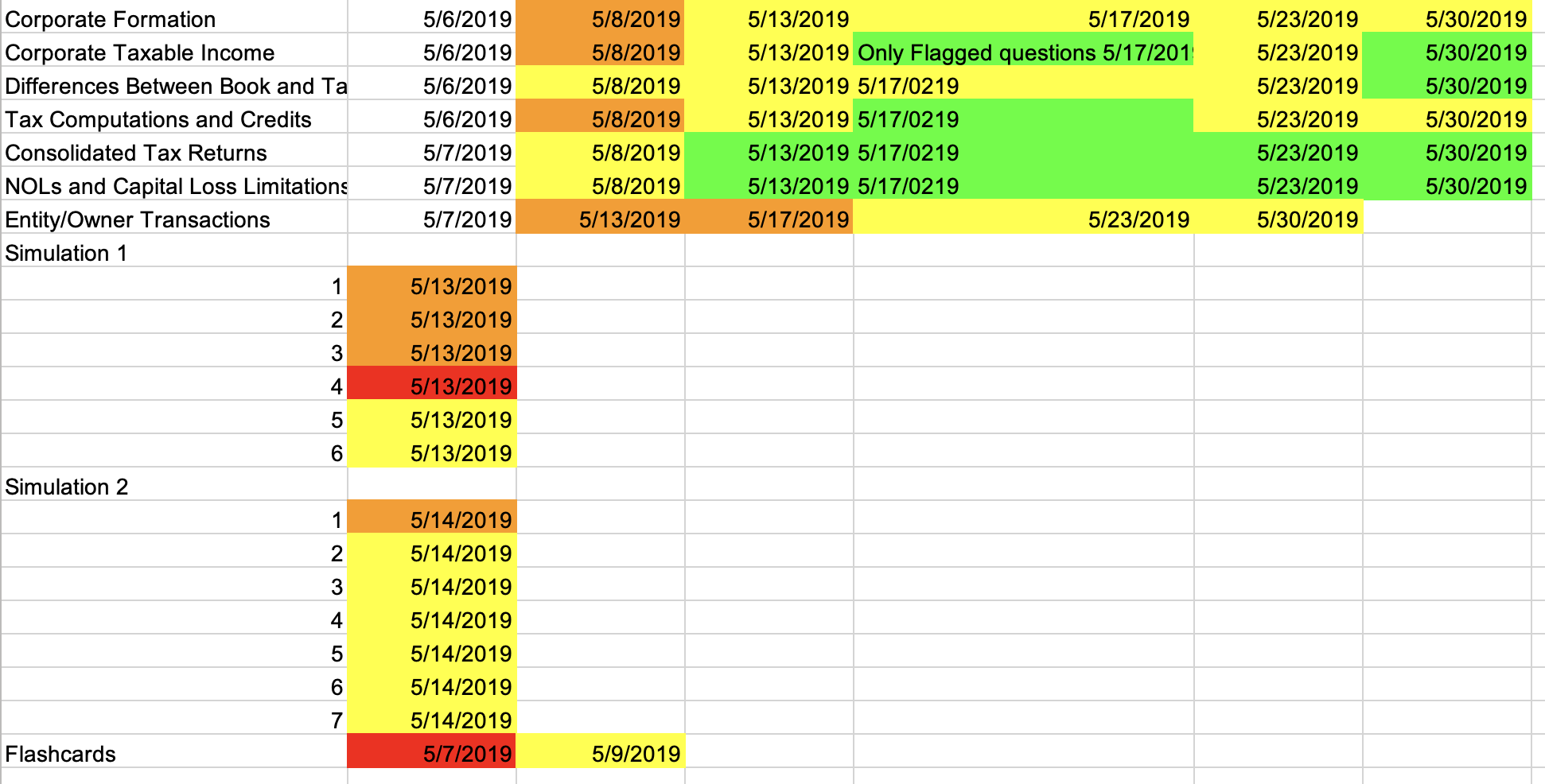

This is the retrospective revision timetable color system I used: red, orange, yellow, green. Red means I really don't know this, orange means I'm starting to learn it but it's still very hard, yellow means I have a good grasp on it but I'm not perfect, and green means I can recite this content in my sleep and I'm scoring above 80% on the MCQ set for that module. This color system helps you know which areas need more attention and which ones don't. I learned this technique from Ali Abdaal on YouTube, who has other great study technique videos too.
- Retrospective Revision Timetable: https://www.youtube.com/watch?v=b7o09a7t4RA&t=641s
- How to Use Google Sheets: https://www.youtube.com/watch?v=iIyDJK_SAjs&t=5s
Becker MCQs, Simulations, and Flashcards
During the first three weeks, while going through the content as described above, I was also doing about 10 to 20 question personalized review sessions — a Becker feature for each chapter — each day. This was very helpful: with Becker's machine learning, it knows where your weak spots are and quizzes you more on that content than what you already know.
I also did the simulations for each chapter after finishing the learning portion. As you can see in the screenshot above, I started the first simulation for chapter 4 on 5/13/2019. I'd learn from where I went wrong and write out any equations or important information on paper. I reviewed those notes regularly but didn't practice simulations very much beyond that, because as long as you understand what a simulation looks like and how it's graded, you should be fine — the odds of a similar simulation showing up on your actual exam are slim. Still, do your best to learn what each simulation has to offer.
I also used the digital flashcards Becker offers for each chapter to master vocab and formulas — I found these very helpful. I also borrowed the physical Becker flashcards, which are more in-depth than the digital ones, and that was a game changer for my understanding of the content. Becker does a phenomenal job putting those together.
Weeks 4–6: Final Review
After getting through the content in three weeks, I had three more weeks to review before the exam. At this point I went straight into the final mock exam and started the Final Review. Do the Final Review — it helped me understand the content so much better than slowly grinding through the nitty-gritty details in the main textbook again.
Each day entailed going through 200+ MCQs from online.becker.com and the Final Review software. I'd recommend using the personalized review sessions for MCQs, but I didn't discover that feature until I started studying for Audit five months later. I'd also do a handful of simulations every day, rewatch a lecture on hard topics, go through homemade flashcards and Becker flashcards, and do a Becker mock exam every three days. Even though I started to remember the questions and answers on the mock exam, I thought it was simply good practice to get used to the size of the exam, and the questions were always a good overview of each chapter. Plus, after going through a mock exam a couple of times, I could get through each one in an hour to two hours, tops — it didn't consume too much time.
My Final Days Before REG
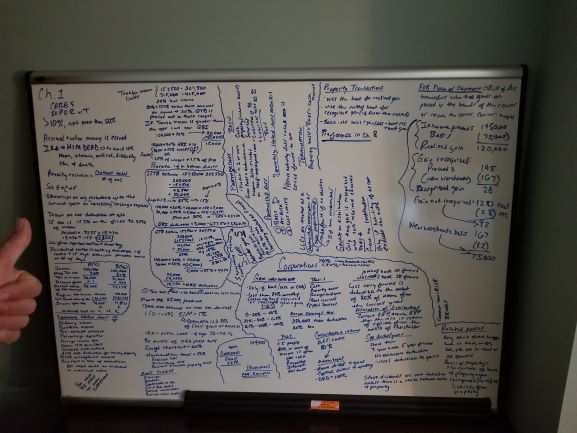
In the final days before the exam, I was still going through a bunch of MCQs, simulations, and flashcards every day, but I also had a whiteboard that I filled up with all of my hard topics. If you don't have a giant whiteboard, you can simply put these concepts in a notebook if you're trying to do what I did. This helped me a ton — when I was in the exam and a question came up relating to something on that whiteboard, my mind knew right where it was, like a photographic memory, and it was easy to jot down a formula or remember a rule. My dad actually encouraged me to take a picture of the whiteboard and gave me a thumbs up when I did — thanks for the encouragement, Dad.
Exam Day and Result
I took the exam on June 7, 2019, and passed with a 78.
As you study and go through the process, you'll figure out what works for you. Do what works for you, and just keep doing more of it until you take the exam. Trust me — the process will go by fast and will be over before you know it. Enjoy the process.
Study Resources
A few more very useful study videos — these helped me understand how to study and prepare for a big exam like this, since exams in college are so small in comparison to the CPA exams:
- How To Study For Exams Pt. 1: https://www.youtube.com/watch?v=ukLnPbIffxE&t=11s
- How To Study For Exams Pt. 2: https://www.youtube.com/watch?v=Z-zNHHpXoMM
- What I Did 24hrs Before My Medschool Final (VLOG): https://www.youtube.com/watch?v=gqiYzlW3sqg&t=234s