FAR
Financial Accounting and Reporting — the second of the four sections I sat for.
June 10, 2019
Started FAR
Began working through Becker immediately after taking REG.
Weeks 1–2
Learn + review
Worked through new chapters each day while using MCQs and flashcards to keep earlier material fresh.
Week 2
Retrospective revision
Started tracking each section in a spreadsheet so I could see what I had reviewed, what I was forgetting, and what needed more work.
Week 4
First pass complete
Finished all 10 chapters — lectures, MCQs, and simulations — in about four weeks.
Weeks 5–6
Final Review
Shifted toward cumulative MCQs, Becker Final Review, mock exams, flashcards, simulations, and weak areas.
Week 7
Everything becomes cumulative
Hundreds of MCQs, repeated review, and less time learning anything new.
July 27, 2019
Exam day
Seven weeks after starting, I sat for FAR and ultimately passed with a 76.
I took FAR in 2019. The CPA exam itself and the Becker software have both changed since then, so some of the specifics below are dated — but the study strategies still hold up.
How I Passed FAR in 7 Weeks
FAR was the most difficult of the four exams for me, simply because of how much content there was to know. It was my second exam, right after Regulation, and I spent seven weeks studying for it.
I started on June 10, 2019. It took me about four weeks to get through the FAR Becker book, including the lectures, multiple-choice questions, and simulations. I spent the final three weeks reviewing: mock exams, flashcards, Final Review, and hundreds of multiple-choice questions.
Weeks 1–4: Getting Through the FAR Material
Within the first four weeks, I made sure to keep up with previous chapters by working through multiple-choice questions and revisiting old content as I moved forward. I kept up on old material using a retrospective revision timetable — the same technique I used for REG, which I originally got from Ali Abdaal's YouTube video on the subject.
By the end of week four, I had gone through all of the content and felt somewhat confident with it.
How I Used a Retrospective Revision Timetable
A retrospective revision timetable is simply a spreadsheet with a row for each section of each chapter. I'd color-code each section based on how well I knew the content, and put the date in the row so I could see when I'd last studied it. Instead of trying to remember what I needed to study, I could look at the sheet and know.
Reviewing a section meant going through all of its multiple-choice questions, reading back through that part of the book, and making sure I actually understood the content. I'd always ask myself whether I could explain the concept to a five-year-old — if I couldn't explain it clearly, I probably didn't understand it well enough.
If I scored well on the MCQs for a section and understood the content, I marked it green. If I didn't know it well, yellow. If a section was genuinely difficult, orange — or red if I really needed more practice. I tried to make sure every previous section got reviewed within the past three days, which got harder near the end of the book since there's so much content by then. But it's necessary — the retrospective revision timetable makes it easy to track everything so nothing falls through the cracks.
The colors weren't the whole system, though. Next to a lot of the cells I also wrote myself short notes on what specifically still needed work — things like which question sets to go back to, which journal entries I still needed to know cold, or which sub-areas of a chapter were giving me trouble. The color told me how urgent a section was; the note told me what to actually do about it.
Ali Abdaal's video on the retrospective revision timetable technique is here: https://www.youtube.com/watch?v=b7o09a7t4RA&t=641s. If you want to see what mine actually looked like, there's a screenshot and the full sheet at the end of this page.
Weeks 5–7: Final Review
Once I'd gotten through all of the content, the last three weeks were entirely about review.
My Final Review Routine
- Do each of the Becker mock exams at least twice.
- Do roughly 200–400 multiple-choice questions a day. Becker's personalized review sessions are an amazing tool here — they quiz you on your weak topics specifically.
- Do a few simulations each day to get a feel for what the FAR simulations look like.
- Do the free AICPA mock exam on the AICPA website. It's a good way to get a feel for the real exam's format and level of difficulty.
- Go through Becker's digital flashcards, plus any physical flashcards I'd made for myself.
- Review the red, orange, and yellow sections in my retrospective revision timetable — but don't skip the green ones, no matter how confident you feel.
- Do the multiple-choice questions in the final review software for extra practice. Of everything I did, MCQs were probably the most important part of my final review. They forced me to retrieve the information instead of simply rereading it, and every wrong answer showed me something I still needed to work on.
One thing that stuck with me from this stretch: on July 15, 2019, I was scoring around 59–60% on the Final Review MCQ sets. By July 21, I'd recorded a 77% on an "All" set. The exact percentages aren't important. What mattered was that the repetition was working. Things that had felt unfamiliar a week earlier were starting to become automatic.
Exam Day and Result
I took FAR on July 27, 2019.
Before the exam, I had actually written "83" in my planner because I had recently read The Secret and apparently thought I could manifest my CPA score into existence. I didn't quite nail that prediction.
I got a 76.
One point over passing was plenty.
I found out I'd passed on August 22, 2019. After REG and FAR, I was officially halfway through the CPA exam.
My FAR Retrospective Revision Timetable
The actual workbook has ten tabs, F1 through F10, plus a Final Review MCQ tracking sheet. I won't post a screenshot of every tab here — one representative view is enough to show how the system worked, and the full sheet is linked below if you want to see the rest.
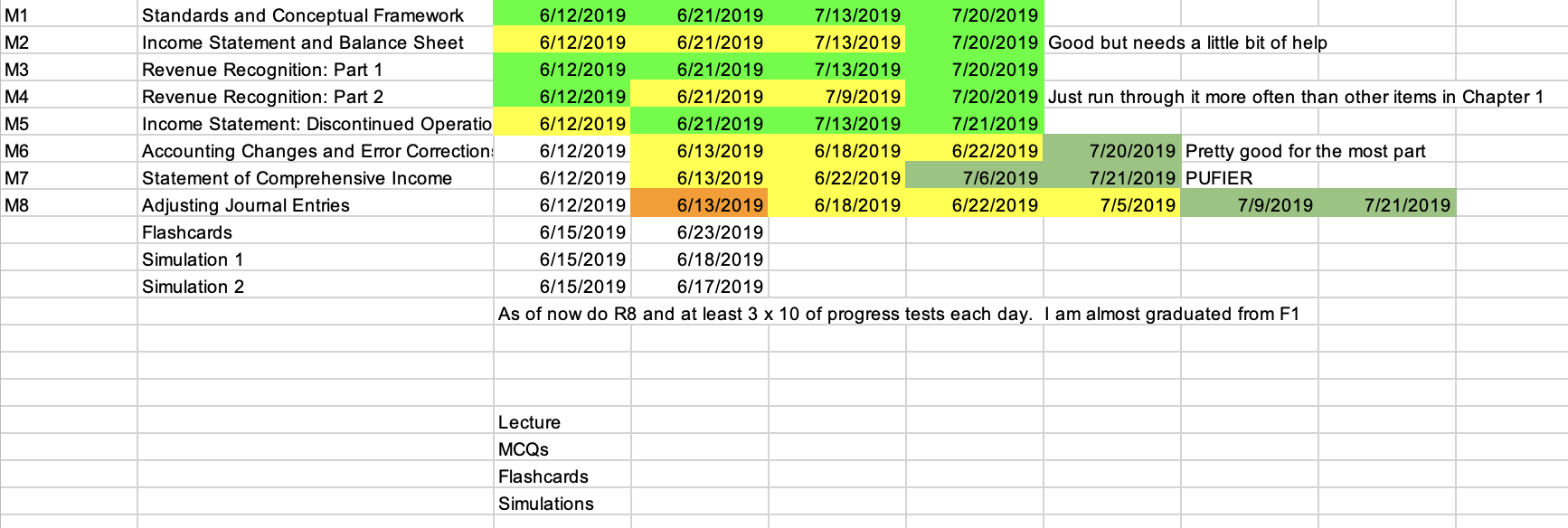

Here's the full Google Sheet. Good luck!